
The alpha engine, in two steps.
Reads the regime, drafts the rebalance, routes it through your policy gate and sign-off checkpoints, executes, and logs one audit-grade entry — every cycle, every basis point accounted for.
Regime Detection
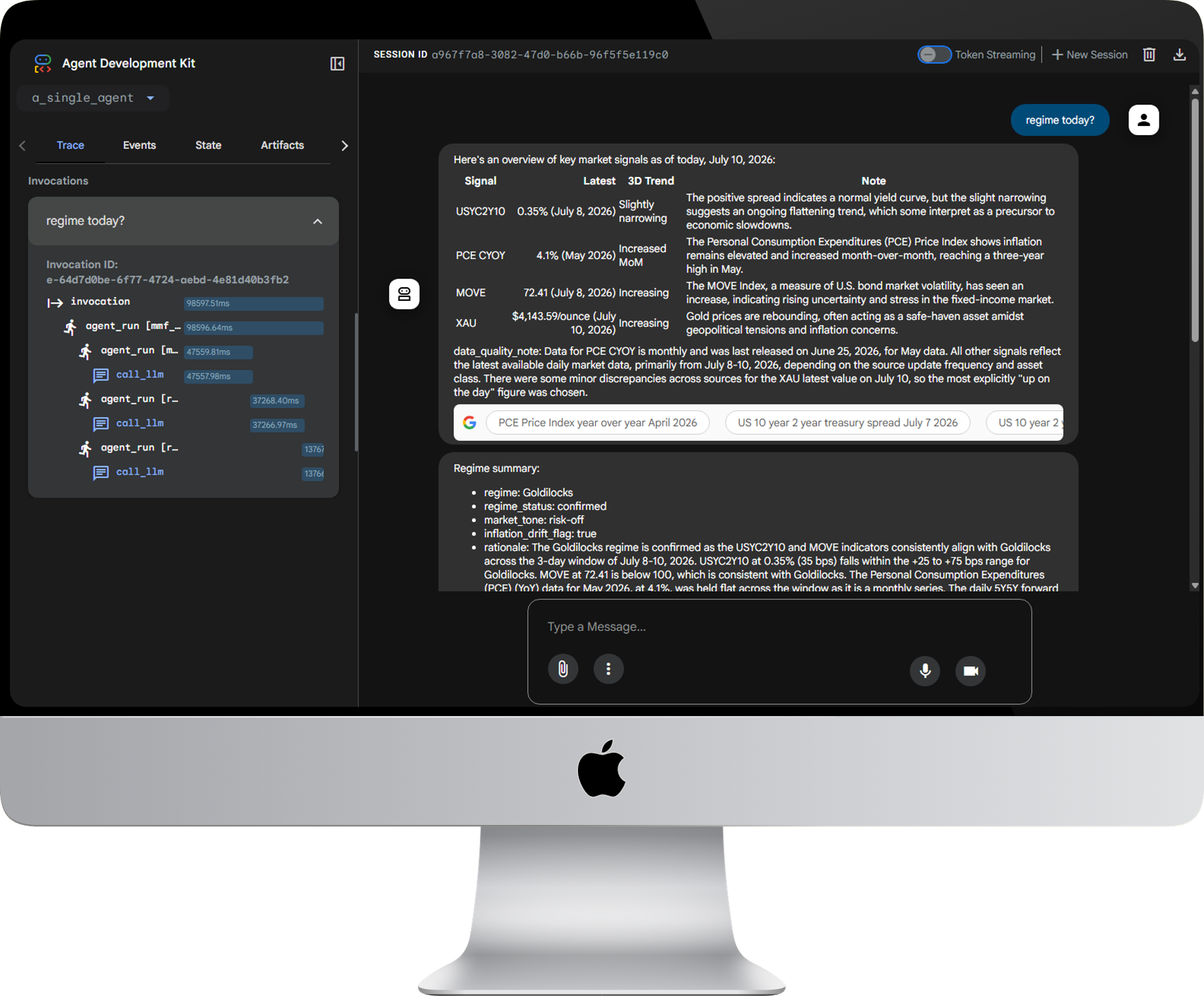
A Hidden Markov Model classifies macro conditions into four regimes — Goldilocks, AI Boost, Stagnation, Stagflation — on a 3-day confirmation cycle, using observable market data.

Probabilistic, not predictive
regime likelihood, not price forecasts.
Four defined states
never an undefined signal.
Rebalance Rule
An agentic workflow reads the regime signal, drafts the rebalance instruction, routes it through policy approval and defined human sign-off checkpoints, executes, and writes the audit log entry.
Checkpoint-gated
humans sign off before execution, not after.
Fully logged
signal, draft, approval, execution — one traceable entry.

Alpha compounded
Regime-aware rebalancing captures many small, low-risk improvements as conditions shift between the four states — compounding into 150–200bps of alpha over a single parked fund.

No
speculation
the mix only, never direction.
Reviewable math
every basis point traceable to its triggering signal.
.gif)
Knowledge that stays
Real-time macro regime reporting, mandatory human sign-off prior to trade execution, and complete end-to-end decision logging.
.gif)
Regime transparency
the current classification — Goldilocks, AI Boom, Stagflation or Stagnation — is visible in reporting at any time.

Institutional memory
every decision and its rationale on file — the strategy survives any departure.

One entry per decision
signal, draft, approval and execution logged together.
Customer testimonials
Clients trust our process through mandatory pre-execution sign-offs, full audit logging, and actionable clarity on how regime shifts drive cash allocation decisions.

Treasurer
Institutional Client


CFO
Corporate Treasury
Run your mandate through the engine
A private assessment maps your current fund mix against the allocation opportunity, before any commitment is made.
Frequently asked questions
Frequently asked questions ordered by popularity. Remember that if the visitor has not committed to the call to action, they may still have questions (doubts) that can be answered.
A Hidden Markov Model classifies prevailing market conditions into one of four named regimes — Goldilocks, AI Boom, Stagflation, Stagnation — based on observable data. The classification updates continuously and determines which allocation posture the rebalance rule applies next.
The rebalance workflow runs end-to-end — signal, draft, policy check, execution, audit log — without manual handling at each step. Every instruction still passes an automated policy gate against your written mandate before execution, and the full trail remains reviewable by your team on demand.
The mandate itself: liquidity floor, concentration limits, and permitted instruments. A drafted rebalance instruction is compared against these written constraints before execution proceeds. An instruction outside mandate limits does not clear the gate and is not executed.
Yes. The current classification — Goldilocks, AI Boom, Stagflation or Stagnation — is visible in your reporting alongside the allocation it produced. Regime history and the rebalances associated with each transition remain retrievable for as long as your mandate is active.
Each cycle logs four linked items as one entry: the regime signal that triggered action, the drafted rebalance instruction, the policy-approval result, and the execution confirmation. Nothing executes without a corresponding, timestamped log entry your compliance team can retrieve.